
Bachelor of Civil Engineering
Department of Civil Engineering
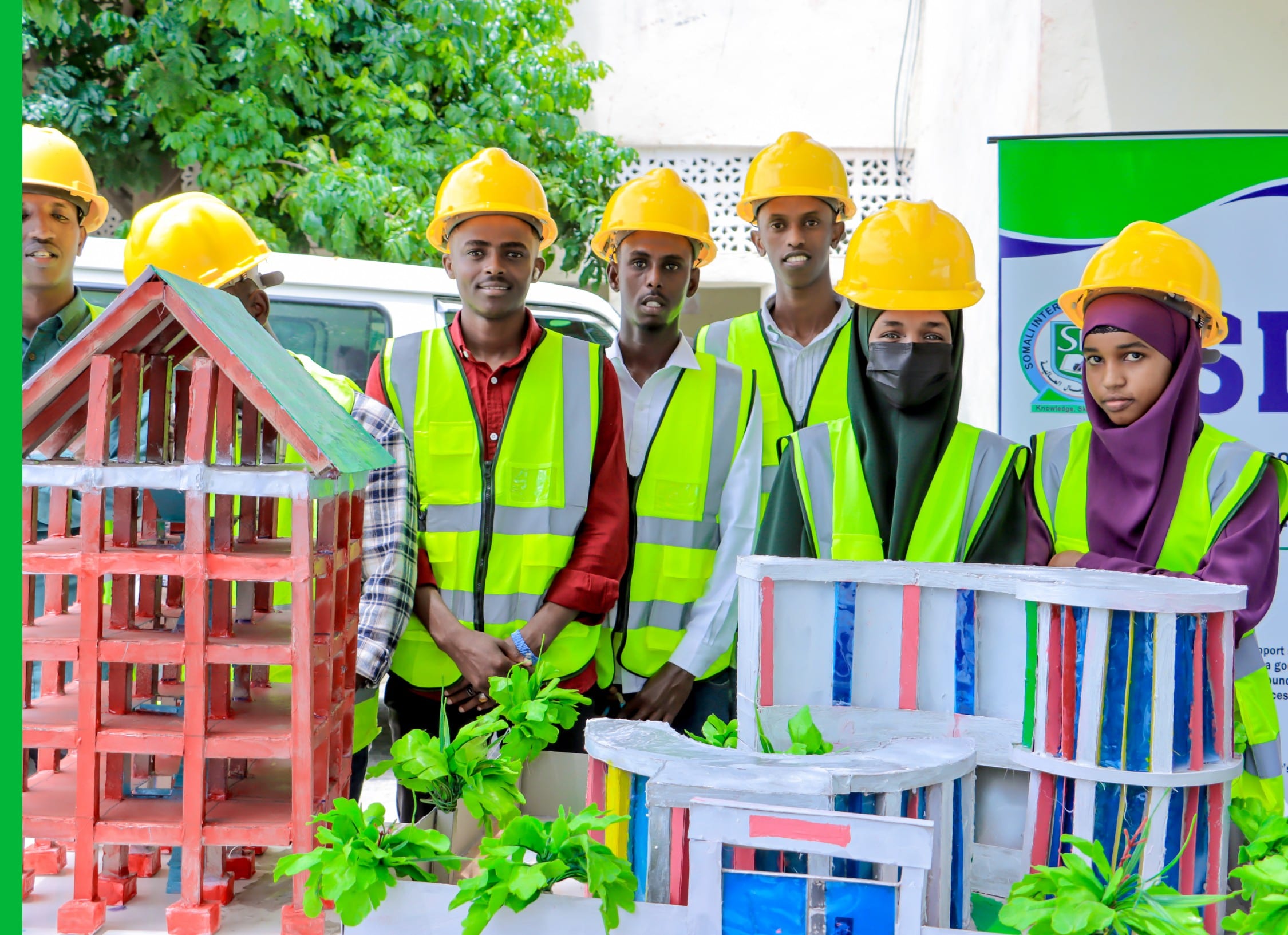
Prepares engineers who can plan, analyse, design, construct, operate and maintain the buildings, roads, bridges, water and sanitation systems and other infrastructure that Somalia's reconstruction and urbanisation depend on.
Degree Awarded
Bachelor of Civil Engineering
Duration
5 Years (10 Semesters)
Total Credit Hours
213 Credit Hours
Total Courses
64 Courses
Language of Instruction
English
Campus Location
Mogadishu, Somalia
Overview
Somalia's reconstruction after decades of conflict depends fundamentally on the physical infrastructure that supports economic and social life: roads, buildings, water and sanitation systems, and flood- and drought-management infrastructure. The country faces a severe shortage of qualified civil engineers capable of designing, constructing, and maintaining this infrastructure safely and sustainably, at the same time as urbanisation — particularly in Mogadishu — is placing growing pressure on existing systems. The Department of Civil Engineering brings together instructors with backgrounds in structural, geotechnical, transportation, water-resources, and environmental engineering, delivering a curriculum structured so that students first build a rigorous foundation in mathematics, physics, and engineering mechanics before progressing into design-focused coursework in structures, geotechnics, hydraulics, and transportation, culminating in two extended, supervised field-attachment placements on real construction sites.
Areas of Study
- Engineering mechanics, strength of materials and structural analysis
- Reinforced concrete and steel structural design
- Soil mechanics, geotechnical engineering and foundation design
- Surveying, geomatics and GIS applications
- Water resources, hydraulics, water supply and sanitary engineering
- Highway and transportation engineering
- Construction materials, quantity surveying, project planning and contract management
- Computer-aided design and structural analysis software (AutoCAD, Civil 3D, ETABS/SAP2000, Revit)
Vision & Mission
To be a leading Civil Engineering programme in Somalia and the Horn of Africa, recognised for producing highly skilled, innovative, and ethical engineers who contribute to sustainable infrastructure development and the advancement of society.
To provide high-quality education in civil engineering that blends theoretical knowledge with practical skills, fostering innovation, ethical responsibility, and a commitment to sustainable development. The programme aims to prepare graduates who can effectively address the infrastructure needs of Somalia and the region, contribute to community advancement, and excel in both local and global engineering environments.
Objectives & Learning Outcomes
- 1Provide Strong Foundations — equip students with comprehensive knowledge of civil engineering principles, mathematics, and applied sciences.
- 2Develop Practical Skills — foster the ability to apply engineering concepts through laboratory experiments, fieldwork, and project-based learning.
- 3Promote Innovation and Problem-Solving — encourage creative thinking to design sustainable and cost-effective engineering solutions.
- 4Enhance Professional Competence — prepare graduates to meet the ethical, technical, and managerial demands of the civil engineering profession.
- 5Support National Development — contribute to Somalia's infrastructure growth by producing engineers capable of addressing local and regional challenges.
- 6Encourage Lifelong Learning — instil the motivation for continuous professional development and adaptation to emerging technologies.
- 1Apply Knowledge — demonstrate a solid understanding of mathematics, science, and engineering fundamentals to solve civil engineering problems.
- 2Design Solutions — develop safe, sustainable, and cost-effective engineering designs that meet societal and environmental needs.
- 3Use Modern Tools — utilise contemporary engineering tools, software, and techniques in analysis, design, and project execution.
- 4Conduct Investigations — plan and carry out experiments, interpret data, and draw valid conclusions in civil engineering contexts.
- 5Work Effectively in Teams — collaborate efficiently in multidisciplinary and multicultural teams to achieve project goals.
- 6Communicate Professionally — present ideas, designs, and reports effectively in both written and oral forms.
- 7Uphold Ethics — adhere to professional ethics, legal responsibilities, and safety standards in engineering practice.
- 8Engage in Lifelong Learning — continuously update skills and knowledge to adapt to evolving technologies and industry trends.
- 9Address Local and Global Challenges — apply engineering solutions to meet the infrastructural needs of Somalia and contribute to global development initiatives.
Programme Duration
- Total duration: five (5) academic years, comprising ten (10) semesters.
- Semester length: seventeen (17) weeks — fifteen (15) weeks of instruction and two (2) weeks of examinations.
- Recess periods: a four-week break following the first semester and a seven-week break following the second semester of each academic year.
- Academic load: 64 courses and 213 credit hours in total, distributed across the ten semesters as prescribed in the Study Plan.
- Credit-hour equivalence: one (1) credit hour equals sixty-four (64) contact hours of combined theoretical and practical instruction.
Admission & Graduation Requirements
Entry Criteria
- High school certificate — grade 12 or equivalent.
- Satisfactory performance on the university entrance examination.
- Satisfactory performance in the personal interview.
Required Documents
- Complete application form.
- Official high school transcript.
- Four passport-size photographs.
- Application fee receipt.
- Complete all required courses (213 total credit hours).
- Pass all core, elective, and general education subjects.
- Maintain a minimum cumulative GPA of 2.00 overall
- Complete the required Field Attachment placements (Field Attachment I and II) and associated site training.
- Successfully finish the Graduation Project (Graduation Project I and II).
- Clear all financial and administrative obligations.
Career Opportunities
Structural engineer
Designing and supervising the construction of buildings, bridges, and other structures.
Transportation engineer
Planning, designing, and managing roadways, highways, and transportation systems.
Geotechnical engineer
Analysing soil and rock conditions to ensure safe and stable foundations.
Water resources engineer
Designing water supply systems, irrigation networks, and flood control structures.
Environmental engineer
Developing solutions for environmental protection, waste management, and pollution control.
Construction project manager
Overseeing construction projects from planning to completion.
Urban planning and infrastructure specialist
Designing and improving urban infrastructure and community development projects.
Academic and research roles
Engaging in teaching, training, and engineering research.
Government and public sector engineer
Working with ministries, municipalities, and public agencies on infrastructure projects.
Delivery & Assessment
- Lectures and Classroom Discussions
- Laboratory Sessions
- Fieldwork and Site Visits
- Workshops and Seminars
- Project-Based Learning
- Use of Modern Engineering Design Tools and Software
| Assessment Component | Weighting |
|---|---|
| Written Examinations (Midterm 30%, Final 30%) | 60% |
| Practical / Skills Demonstrations | 10% |
| Coursework and Assignments | 10% |
| Lecturer Assessment Note | 10% |
| Attendance and Participation | 10% |
| Total | 100% |
Practical Training
Practical training is central to the programme. In addition to laboratory and studio work throughout the degree, every student completes two extended, supervised field-attachment placements on real construction sites and a supervised graduation project.
- Hands-on laboratory, surveying and workshop practice from the early years.
- Field Attachment I and Field Attachment II — extended, supervised placements on real construction sites under practising engineers.
- A supervised graduation project (Graduation Project I and II) undertaken in the final year.
Faculty and Learning Facilities
- Civil engineering laboratories: materials and concrete testing, soil mechanics, hydraulics, and a surveying equipment store for field training.
- Computer laboratories: networked workstations with current development environments and licensed engineering and design software.
- Design studio and project space for graduation projects, team work and student innovation activities.
- Faculty library and digital resources: technical references, standards and access to online academic databases.
Contact Information
Faculty of Engineering, Somali International University (SIU)