
Bachelor of Agricultural Sciences
Department of Agricultural Sciences
A full-scholarship programme combining theoretical learning with extensive practical training across crop production, animal science, soil and water management, and agribusiness, preparing graduates to address food security and sustainable rural development in Somalia.
Degree Awarded
Bachelor of Agricultural Sciences
Duration
5 Years (10 Semesters)
Total Credit Hours
238 Credit Hours
Total Courses
66 Courses
Language of Instruction
English
Campus Location
Mogadishu, Somalia
Funding
Full-scholarship programme
Overview
Agriculture underpins Somalia's economy and the livelihoods of most of its population, yet the sector remains constrained by low productivity, degraded rangelands, recurrent drought, and a shortage of formally trained agricultural professionals. The Bachelor of Agricultural Sciences programme integrates theoretical learning with practical training, preparing graduates to address issues of food security, sustainable resource management, and rural development. The curriculum opens with foundational University and Faculty Requirement courses in language, communication, mathematics, and the basic sciences, and proceeds through five years of progressively advanced agricultural science coursework spanning crop production, animal science, soil and water management, agribusiness, and sustainable natural-resource management, supported by extensive field and laboratory practical training and culminating in an independent Graduation Project.
Background and Rationale
Somalia's farming and pastoral systems face recurrent drought, soil degradation, and limited access to modern agronomic, veterinary, and agribusiness expertise, while donor-funded and government agricultural programmes report persistent difficulty recruiting graduates with both scientific grounding and practical field competence. Dedicated courses examine drought risk management, rangeland management, climate change and agriculture, and natural resource conservation, reflecting the recurrent challenges facing Somali farmers and pastoralists. By offering this programme as a full scholarship, SIU is fulfilling its social responsibility and ensuring that talented young people have access to agricultural education without financial barriers.
Vision & Mission
To become a leader in sustainable agricultural education, producing graduates who will advance agricultural practices and contribute to global food security.
To provide high-quality education in agricultural sciences that combines theoretical learning with practical training. The programme emphasises sustainable farming, research, and technology to enhance productivity and support rural development, with a commitment to ethical practices and community outreach.
Objectives & Learning Outcomes
- 1Provide students with comprehensive knowledge in agricultural sciences, including plant biology, soil science, pest management, and crop production.
- 2Equip students with the ability to apply modern agricultural technologies to improve productivity and efficiency.
- 3Promote the integration of sustainable and environmentally friendly agricultural practices that also ensure economic viability.
- 4Build knowledge of agricultural economics and policy to prepare students for engagement in global agricultural trade and development.
- 5Develop students' research capacity to address agricultural challenges through innovation and scientific inquiry.
- 6Strengthen students' communication skills to effectively share agricultural knowledge with diverse audiences.
- 7Prepare students to lead agricultural projects, manage resources, and foster innovation in the field.
- 8Train students to support farmers and communities through extension services, promoting knowledge transfer and sustainable development.
- 1Demonstrate a comprehensive understanding of core agricultural science principles, including plant biology, soil science, pest management, and crop production systems.
- 2Apply modern agricultural technologies to improve farming practices and productivity.
- 3Integrate sustainable farming practices that promote environmental conservation while optimising agricultural output.
- 4Apply knowledge of agricultural economics and policy to understand global agricultural markets, trade, and the role of agriculture in economic development.
- 5Conduct independent research and contribute to solving critical challenges in the agricultural field.
- 6Communicate agricultural knowledge effectively to a variety of audiences.
- 7Lead agricultural projects, manage resources, and ensure efficient agricultural practices.
- 8Demonstrate the ability to transfer agricultural knowledge to farmers and communities, helping to improve practices and contribute to agricultural development through extension services.
Programme Duration
- Total duration: five (5) academic years, comprising ten (10) semesters, each seventeen (17) weeks long — fifteen (15) weeks of instruction and two (2) weeks of examinations.
- Recess periods: a four-week break following the first semester and a seven-week break following the second semester of each academic year.
- Course load: students typically undertake between four (4) and seven (7) courses per semester, with the final semester intentionally limited to a smaller course load around the Graduation Project.
- Academic load: 66 courses and 238 credit hours in total, distributed across the ten semesters as prescribed in the Study Plan.
- Credit-hour equivalence: one (1) credit hour equals 45 contact hours of combined theoretical and practical instruction.
Admission & Graduation Requirements
Entry Criteria
- High school certificate — grade 12 or equivalent.
- Satisfactory performance on the university entrance examination.
- Satisfactory performance in a personal interview.
Required Documents
- Complete application form.
- Official high school transcript.
- Four passport-size photographs.
- Application fee receipt.
- Complete all required coursework and agricultural components, totalling 66 courses and 238 credit hours.
- Maintain a minimum cumulative GPA of 2.00 overall
- Pass a final comprehensive practical examination.
- Fulfil all academic, ethical, and attendance policies of the Faculty.
Career Opportunities
Agricultural Scientist
Farm Manager
Agribusiness Manager
Agricultural Engineer
Crop Production Specialist
Animal Scientist
Agricultural Extension Officer
Agricultural Policy Analyst
Environmental Consultant
Agriculture Educator / Instructor
Agricultural Consultant
Delivery & Assessment
- Classroom-based lectures.
- Practical laboratory sessions.
- Fieldwork and farm practicums.
- Projects and group assignments.
- Seminars and guest lectures.
| Assessment Component | Weighting |
|---|---|
| Written Examination | 60% |
| Practical / Fieldwork Reports | 20% |
| Class Assignments and Quizzes | 10% |
| Presentations and Participation | 10% |
| Total | 100% |
Practical Training
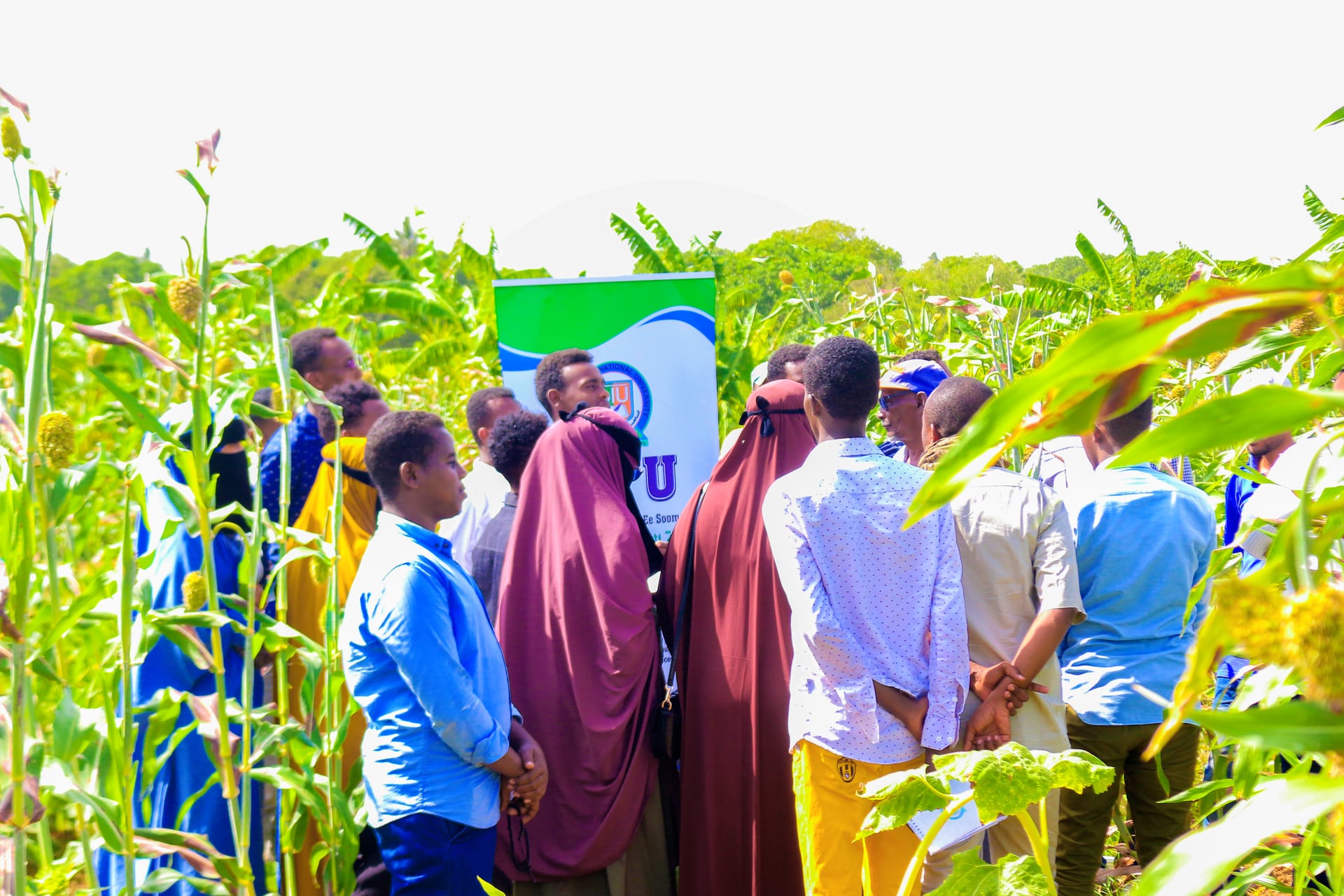
Practical training is a key component of the programme, allowing students to apply their theoretical knowledge in real-world agricultural settings. The training spans 6–12 weeks.
- Land preparation.
- Soil testing and fertility management.
- Pest and disease control.
- Harvesting and post-harvest handling.
- Irrigation system setup and maintenance.
- Field trials and experimentation.
Faculty and Learning Facilities
- All instructors hold professional degrees in Agricultural Science or related fields, with extensive teaching and agriculture experience.
- Students have access to well-equipped simulation labs, computer labs, a laboratory skills centre, and the university library.
- Field training is conducted in collaboration with partner farmers, agricultural companies, and environmental centres.
Contact Information
Faculty of Agricultural and Environmental Sciences, Somali International University (SIU)