
Bachelor of Business Administration
Department of Business Administration
Develops broadly capable managers through an integrated curriculum spanning management, marketing, operations, human resources, finance and strategy, with experiential and problem-based learning and workplace internship.
Degree Awarded
Bachelor of Business Administration
Duration
5 Years (10 Semesters)
Total Credit Hours
204 Credit Hours
Total Courses
72 Courses
Language of Instruction
English
Campus Location
Mogadishu, Somalia
Overview
Somalia's private sector is dominated by family-owned enterprises and small and medium businesses that are expanding beyond the scale at which informal management can sustain them, and the country's long-term development depends on a supply of managers able to formalise and grow these businesses. The Bachelor of Business Administration provides a strong foundation across management, marketing, operations, human resources and finance, while building applied competence through progressive, hands-on workplace practicals that run across the degree phase, treating general management competence and entrepreneurial capability as equal priorities rather than alternatives.
Background and Rationale
Employers consistently report shortages in supervisory capability, formal planning, performance management and the use of business information systems, while a high proportion of graduates go on to create their own enterprises rather than enter salaried employment. A dedicated course examines the structure and challenges of the Somali business environment directly, and further courses examine small and medium enterprise management, family business and succession, and electronic commerce, reflecting the enterprise structures graduates are most likely to join or found.
Vision & Mission
To be the department of choice in Somalia for general management education, producing versatile and enterprising managers who lead organisations effectively in a changing regional and global economy.
The Bachelor of Business Administration programme develops broadly capable managers through an integrated curriculum spanning management, marketing, operations, human resources, finance and strategy. It emphasises experiential and problem-based learning, workplace internship, and the development of leadership, entrepreneurial and analytical capability, so that graduates can build and manage enterprises that contribute to Somalia's economic development.
Objectives & Learning Outcomes
- 1Provide Integrated Business Grounding — provide an integrated grounding in the functional areas of business and their interaction.
- 2Develop Analytical Capability — develop analytical capability sufficient to diagnose business problems and evaluate alternative courses of action.
- 3Build Entrepreneurial Capability — build entrepreneurial capability, from opportunity identification through to a financed and operable business plan.
- 4Develop Leadership and Team Competence — develop leadership, negotiation and team competence through experiential learning and supervised internship.
- 5Establish Digital Business Fluency — establish fluency in business information systems and digital business practice.
- 6Instil Ethical Judgement — instil ethical judgement and social responsibility in management decision-making.
- 1Explain core management, marketing, operations and organisational-behaviour concepts and their application to business decisions.
- 2Analyse business problems using quantitative, statistical and information-systems tools and recommend evidence-based solutions.
- 3Formulate and evaluate business strategy in response to competitive, regulatory and macroeconomic conditions.
- 4Design and appraise a business plan for a new or existing venture, including its financial and operational feasibility.
- 5Apply human-resource, project and quality-management practices to plan, lead and monitor organisational activity.
- 6Demonstrate professional workplace competence through supervised internship in a business or public-sector organisation.
- 7Communicate, negotiate and work effectively within teams in a professional context.
- 8Exercise ethical judgement and social responsibility in management decision-making.
Programme Duration
- Total duration: five (5) academic years, comprising ten (10) semesters, each sixteen (16) teaching weeks in length.
- Programme phases: Foundation Year (Semesters I–II, 44 credit hours) followed by the Degree Phase (Semesters III–X, 160 credit hours). A student must pass all 44 Foundation Year credit hours before registering for any Semester V course.
- Course load: minimum full-time load of 15 credit hours; a normal load of 18–21 credit hours; a maximum of 22 credit hours in the Foundation Year or 21 credit hours in the Degree Phase.
- Academic load: 72 courses and 204 credit hours in total, distributed across the ten semesters as prescribed in the Study Plan.
- Credit-hour equivalence: one (1) credit hour equals sixteen (16) contact hours of instruction per semester, together with the independent study needed to meet the course's learning outcomes.
Admission & Graduation Requirements
Entry Criteria
- Somali Secondary School Certificate or a recognised equivalent, with a minimum aggregate of 60%.
- Satisfactory performance on the English and mathematics placement tests, sat by all admitted students before Semester I registration.
Required Documents
- Complete application form.
- Official high school transcript.
- Four passport-size photographs.
- Application fee receipt.
- Complete all 72 required courses, totalling 204 credit hours, across ten semesters.
- Achieve a minimum grade of D (50%) in every course.
- Maintain a minimum cumulative GPA of 2.00 overall
- Complete all prescribed Skills, Professional Practice and Internship requirements, with a satisfactory supervisor report for each.
- Successfully complete and defend Graduation Project I and II.
- Pass the comprehensive exit examination assessing programme-level mastery of knowledge, skills and professional values.
- Clear all financial and library obligations.
Career Opportunities
General Manager / Administrator — in private enterprises and public-sector organisations.
Human Resource Officer — managing recruitment, training and employee relations.
Marketing and Sales Executive — in commercial and service-sector organisations.
Operations and Supply Chain Officer — managing production, logistics and procurement.
Entrepreneur — founding and managing a small or medium enterprise.
Project Officer — planning and coordinating organisational or donor-funded projects.
Business Analyst — using information systems and analytics to support management decisions.
Public Relations Officer — managing organisational communication and reputation.
Delivery & Assessment
- Lectures for core concept delivery across all taught courses.
- Tutorials and problem classes for quantitative and technical courses.
- Seminars and discussion forums for theory, policy and ethics courses.
- Computer laboratory sessions for software, modelling and data-analysis courses.
- Case study analysis in applied and specialisation courses.
- Group projects and presentations, assessed within coursework.
- Industry visits, at least one per academic year.
- Practitioner-delivered sessions in specialisation courses.
- Supervised professional internships.
- Supervised research for the Graduation Project.
| Assessment Component | Weighting |
|---|---|
| Coursework (quizzes, assignments, reports, presentations, group projects, practical exercises) | 40% |
| Midterm Examination | 20% |
| Final Examination | 40% |
| Total | 100% |
Practical Training
The Bachelor of Business Administration programme places significant emphasis on hands-on, supervised practical training that complements classroom instruction throughout the five years of study.
- Progressive Administrative Skills Strand — a dedicated Skills course runs in most semesters of the degree phase, progressing from data entry and office practice through customer care and supervisory skills to employability preparation.
- Office Practice — Internship I — supervised practice in general office administration in a business or simulated office setting.
- Sales & Marketing Skills — Internship II — supervised practice in selling and marketing activities in a business setting.
- Field Practice — Internship III — a further supervised professional placement applying business-administration skills developed across the programme.
- Industry Visits — at least one organised industry or institutional visit per academic year.
- Graduation Project I and II — the capstone research project in Year 5 requires each student to design, conduct and defend an original piece of business-administration research.
Faculty and Learning Facilities
- Classrooms — equipped with projection and presentation facilities.
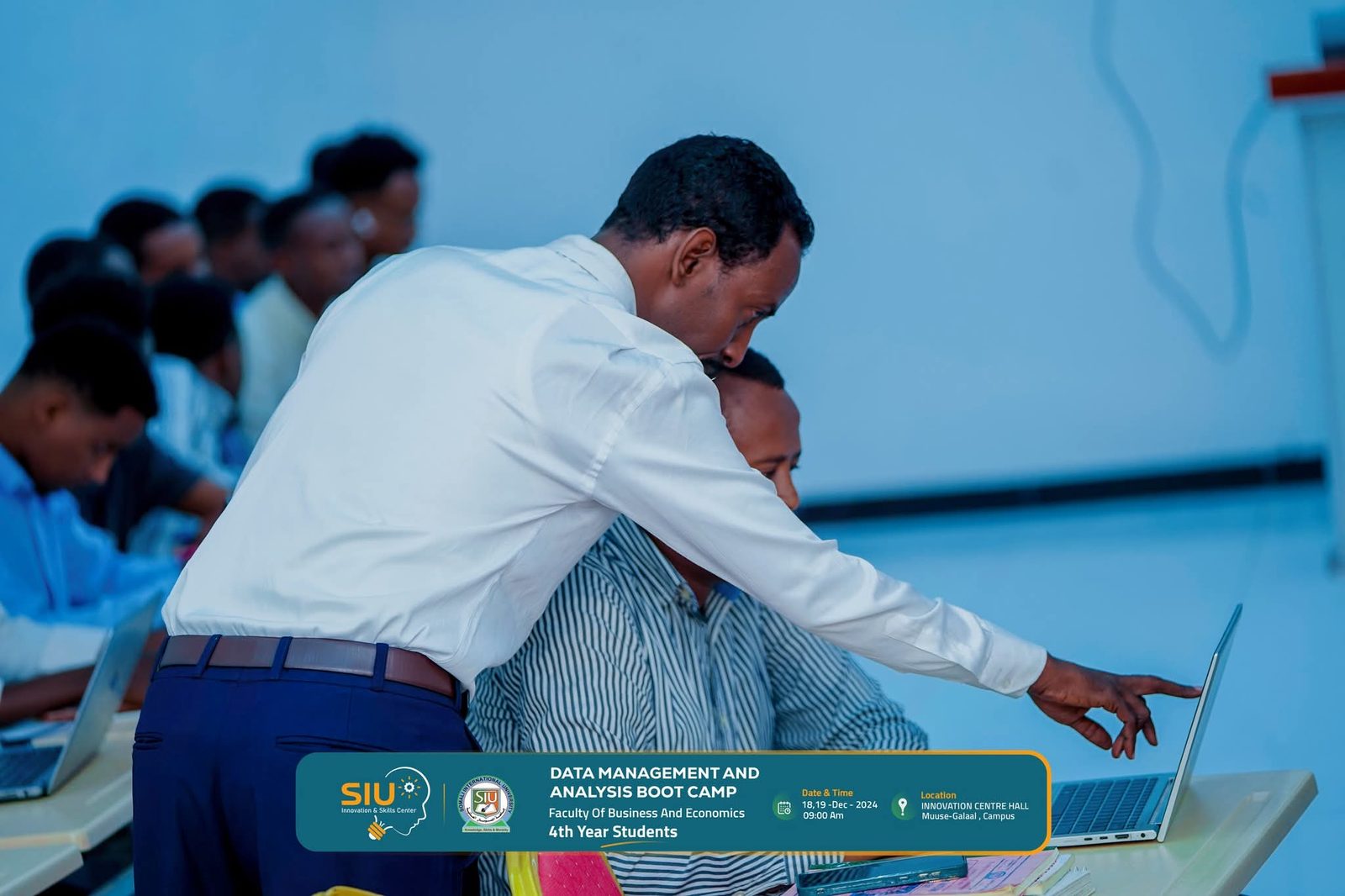
- Computer Laboratory — specialised software for business, financial and statistical analysis, and management information systems, with high-speed connectivity.
- Library — a print collection in business administration and economics, with access to online databases and journals.
- Learning Management System — SIU Online and the student portal for materials, submission and communication.
- Academic Staff — qualified lecturers with relevant postgraduate qualifications, and practitioner lecturers for specialisation courses.
- Student Support — academic advising, careers guidance, and internship placement services.
- Community Engagement — facilities for workshops, seminars, employer events, and outreach.
Contact Information
Faculty of Business and Economics, Somali International University (SIU)