
Bachelor of Cyber Security and Digital Forensics
Department of Cyber Security and Digital Forensics
Prepares professionals capable of protecting digital systems, networks, applications, data and organisational infrastructure from cyber threats, while providing the knowledge and practical skills required to investigate cyber incidents and analyse digital evidence.
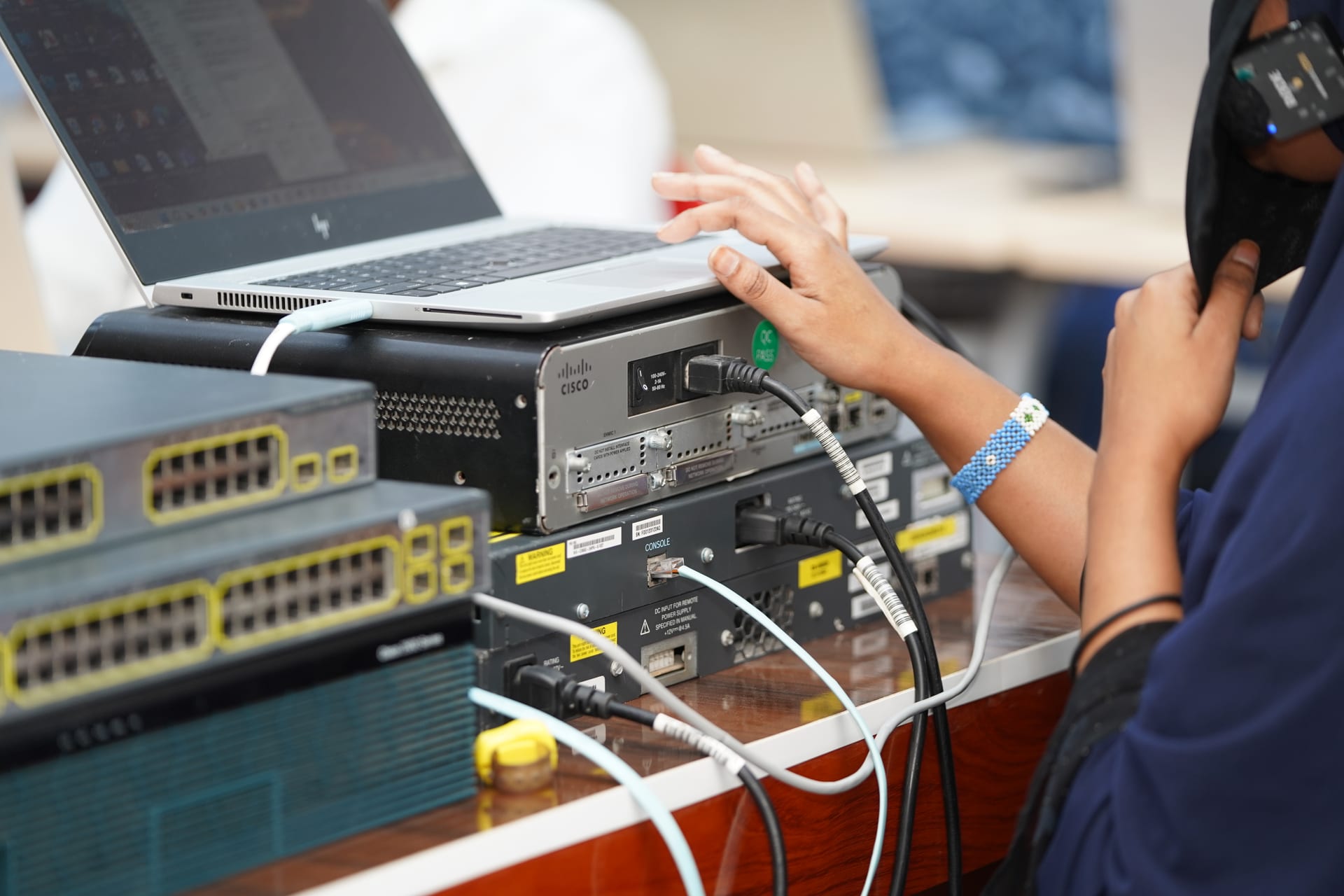
Degree Awarded
Bachelor of Cyber Security and Digital Forensics
Duration
5 Years (10 Semesters)
Total Credit Hours
206 Credit Hours
Total Courses
67 Courses
Language of Instruction
English
Campus Location
Mogadishu, Somalia
Overview
Demand for cybersecurity and digital-forensics competence in Somalia substantially exceeds supply, and the country's digital resilience depends on a growing supply of professionals able to protect systems and investigate incidents to a professional standard. Growth in commercial and mobile banking, telecommunications, e-government services and donor-funded digital infrastructure has raised the exposure of Somali institutions to cyber threats, while employers consistently report a shortage of staff able to secure networks, respond to incidents and conduct forensically sound investigations. The curriculum builds systematically from programming, mathematics and networking fundamentals through operating systems, cryptography and network security to specialised study in digital forensics, ethical hacking, malware analysis, cloud security and cybercrime investigation.
Vision & Mission
To become a leading academic centre for Cyber Security and Digital Forensics education, producing highly skilled, ethical, innovative and professionally competent graduates who contribute to securing and protecting Somalia's and the global digital environment.
To provide quality education, practical training and research in Cyber Security and Digital Forensics, while promoting ethical practice, innovation and professional excellence to protect the digital environment.
Objectives & Learning Outcomes
- 1Build Foundational Competence — provide strong theoretical and practical foundations in cybersecurity, information security, computer networks, operating systems and secure computing.
- 2Develop Risk and Defense Competence — develop the ability to identify, assess and manage cybersecurity risks and vulnerabilities, and apply network defense, ethical hacking, cryptography and incident-response measures.
- 3Build Digital-Forensics Competence — equip students with practical competencies in the acquisition, preservation, examination, analysis, documentation and reporting of digital evidence.
- 4Instil Legal and Ethical Practice — prepare graduates to investigate cyber incidents while observing legal, ethical, privacy and professional requirements.
- 5Align with Professional Standards — align the curriculum with internationally recognised cybersecurity and digital-forensics frameworks to support professional certification.
- 6Develop Professional and Research Skills — develop graduates' analytical thinking, problem-solving, communication, teamwork, research and continuous professional-development skills.
- 1Demonstrate knowledge of cybersecurity principles, information security, networks, systems and secure computing.
- 2Explain the legal, ethical, privacy and professional standards governing cybersecurity and digital-forensics practice.
- 3Identify, assess and manage cybersecurity risks, vulnerabilities and threats using appropriate security techniques and controls.
- 4Analyse cyber incidents and digital evidence to determine root cause, scope and impact.
- 5Apply digital forensic methods to acquire, preserve, examine, analyse and report digital evidence.
- 6Design and implement secure network and system architectures.
- 7Apply cryptographic and secure-software-development principles to protect data and systems.
- 8Operate industry-standard security, forensic and monitoring tools competently in a laboratory or applied setting.
- 9Conduct a supervised research investigation into a cybersecurity or digital-forensics problem and report the findings to an academic standard.
- 10Demonstrate critical thinking, integrity, teamwork and commitment to continuous professional development.
Programme Duration
- Total duration: five (5) academic years, comprising ten (10) semesters, each sixteen (16) teaching weeks in length.
- Academic load: 67 courses and 206 credit hours in total, distributed across the ten semesters as prescribed in the Study Plan.
- Credit-hour equivalence: one (1) credit hour equals sixteen (16) contact hours of instruction per semester, together with the independent study needed to meet the course's learning outcomes.
Admission & Graduation Requirements
Entry Criteria
- Somali Secondary School Certificate or a recognised equivalent, with a minimum aggregate of 60%, with good grades especially in Mathematics and Physics.
- Satisfactory performance on the English and mathematics placement tests, sat by all admitted students before Semester I registration.
Required Documents
- Complete application form.
- Official high school transcript.
- Four passport-size photographs.
- Application fee receipt.
- Complete all 67 required courses, totalling 206 credit hours, across ten semesters.
- Pass all University, Faculty and Department Requirement courses, with a minimum grade of D in each.
- Maintain a minimum cumulative GPA of 2.00 overall
- Complete the One-Year Professional Skill Programme at the SIU Innovation and Skills Centre.
- Complete six (6) months of supervised Internship.
- Successfully complete and defend Graduation Project I and II.
- Clear all financial and administrative obligations.
Career Opportunities
Cybersecurity Analyst
Information Security Analyst
Security Operations Center (SOC) Analyst
Cybersecurity Engineer
Network Security Engineer
Ethical Hacker / Penetration Tester
Vulnerability Assessment Analyst
Incident Response Analyst
Digital Forensics Analyst / Investigator
Computer Forensics Examiner
Mobile Device Forensics Analyst
Cybercrime Investigator
Malware Analysis Specialist
Information Security Officer
IT Risk and Compliance Analyst
Security Auditor
Cybersecurity Researcher, Trainer or Lecturer
Delivery & Assessment
- Lectures and Interactive Teaching
- Practical Laboratory Training
- Project-Based Learning
- Case-Based Learning
- Research-Based Learning
- Collaborative Learning
- Simulation and Scenario-Based Training
- Internship and Practical Training
- Seminars and Workshops
| Assessment Component | Weighting |
|---|---|
| Coursework and Assignments | 20% |
| Practical and Skill Demonstrations | 20% |
| Midterm Examination | 30% |
| Final Examination | 30% |
| Total | 100% |
Practical Training
Internship or Practical Training is a compulsory component of the programme that enables students to apply classroom knowledge in a professional environment such as banks, telecommunications companies, ISPs, government agencies, law-enforcement institutions, security operations centres and digital forensics laboratories.
- Provide students with real-world experience in cybersecurity and digital forensics.
- Develop practical technical and investigative skills, and familiarity with professional tools, technologies and standards.
- Develop communication, teamwork, reporting and professional conduct.
- Submit an internship report and defend the internship experience when required.
Faculty and Learning Facilities
- Cyber Security Laboratory for network security, ethical hacking, vulnerability assessment and incident response.
- Digital Forensics Laboratory for digital evidence acquisition, examination, analysis and forensic investigation.
- Computer Laboratories equipped with modern computers, networking equipment and required software.
- Network Laboratory for practical training in network configuration, monitoring and security.
- Virtualization and Simulation Environment for safe cybersecurity exercises and attack-defense simulations.
- Library and Digital Resources providing current textbooks, e-books, journals, research databases and professional resources.
Contact Information
Faculty of Computer Technology, Somali International University (SIU)