
Bachelor of Medical Laboratory Science
Department of Medical Laboratory Science
Prepares laboratory scientists who produce the accurate diagnostic results on which clinical decisions depend, covering clinical chemistry, haematology, microbiology, parasitology, immunology, histopathology and blood banking, with strong emphasis on quality control and laboratory safety.
Degree Awarded
Bachelor of Medical Laboratory Science
Duration
5 Years (10 Semesters)
Total Credit Hours
213 Credit Hours
Total Courses
62 Courses
Language of Instruction
English
Campus Location
Mogadishu, Somalia
Overview
Somalia's health system depends on accurate, timely diagnostic testing at every level, from primary health centres to tertiary referral hospitals, yet the country faces a persistent shortage of qualified medical laboratory scientists. The Department of Medical Laboratory Science brings together instructors with backgrounds in bacteriology, haematology, clinical chemistry, parasitology, and histopathology, delivering a curriculum structured so that students build a rigorous foundation in the basic sciences before progressing through a carefully sequenced series of laboratory disciplines, each advancing from foundational to diagnostic-level competence, culminating in two extended hospital internships.
Vision & Mission
The SIU Medical Laboratory Science programme should be one of the leading medical laboratory science programmes in the country, with recognition of graduates for leadership and clinical competence.
The mission of the Medical Laboratory Science programme at SIU is to prepare graduates with the knowledge, skills, and professional behaviours needed to function effectively in a wide range of laboratory settings.
Objectives & Learning Outcomes
- 1Apply the principles that form the basis of Medical Laboratory practice.
- 2Practice safety precautions in medical and research laboratories.
- 3Select, set up, and operate laboratory equipment safely using provided standard operating procedures.
- 4Carry out clinical laboratory procedures to obtain accurate results.
- 5Identify the criticalities and the clinical significance of laboratory tests.
- 6Interpret laboratory results.
- 7Carry out epidemiological research.
- 8Manage healthcare services and resources.
- 9Participate in the multidisciplinary planning, implementation, coordination, and evaluation of healthcare of the individual and community.
- 10Contribute to the development of science and technology through creativity and application of acquired knowledge, skills, and attitudes.
- 11Demonstrate the ability to evaluate own performance.
- 12Plan continuing education for self and others.
- 13Observe the professional code of conduct and ethics.
- 1Apply Medical Laboratory Principles — demonstrate understanding and application of key laboratory practices.
- 2Ensure Safety Practices — implement safety protocols in medical and research laboratories.
- 3Operate Laboratory Equipment — set up and operate laboratory equipment following standard operating procedures.
- 4Conduct Accurate Procedures — perform clinical laboratory procedures accurately.
- 5Identify Clinical Significance — recognise the importance of laboratory tests in diagnosis.
- 6Interpret Results — analyse and interpret laboratory results correctly.
- 7Conduct Epidemiological Research — plan and execute epidemiological studies.
- 8Manage Healthcare Services — oversee healthcare services and resources effectively.
- 9Collaborate in Healthcare Teams — work in multidisciplinary healthcare planning and evaluation.
- 10Contribute to Science and Technology — innovate and apply knowledge to advance science and technology.
- 11Evaluate Own Performance — assess personal performance for continuous improvement.
- 12Plan Continuing Education — engage in self-development and assist in the education of others.
- 13Adhere to Professional Ethics — maintain high ethical standards and professionalism.
Programme Duration
- Total duration: five (5) academic years, comprising ten (10) semesters, each 17 weeks in length.
- Course load: students typically undertake between four (4) and eight (8) courses per semester.
- Academic load: 62 courses and 213 credit hours in total, distributed across the ten semesters as prescribed in the Study Plan.
- Credit-hour equivalence: one (1) credit hour equals 62 contact hours of combined theoretical and practical instruction.
Admission & Graduation Requirements
Entry Criteria
- High school certificate — grade 12 or equivalent.
- Satisfactory performance on the university entrance examination.
- Satisfactory performance in the personal interview.
Required Documents
- Complete application form.
- Official high school transcript.
- Four passport-size photographs.
- Application fee receipt.
- Successfully complete all required coursework and clinical components.
- Pass all courses with no grades of F/Fail, NG/No Grade, or I/Incomplete.
- Maintain a minimum cumulative GPA of 2.00 overall
- Pass a final comprehensive practical examination in medical laboratory techniques and diagnostics.
- Complete Internship I and II and the Graduation Project (I and II).
- Fulfil all academic, ethical, and attendance policies of the faculty.
Career Opportunities
Medical Laboratory Technician / Technologist
Performing tests and analysing samples in hospitals or diagnostic laboratories.
Clinical Laboratory Scientist
Conducting advanced laboratory tests to aid in medical diagnoses.
Research Laboratory Scientist
Engaging in scientific research in academic, government, or private sectors.
Epidemiologist
Studying disease patterns and public-health issues.
Laboratory Quality Control Officer
Ensuring laboratory accuracy and compliance with regulations.
Laboratory Manager
Managing laboratory operations and staff.
Healthcare Consultant
Advising on laboratory management and healthcare services.
Delivery & Assessment
- Classroom-based lectures
- Practical laboratory sessions
- Supervised clinical placements
- Simulation-based training
- Case studies, role plays, and group projects
| Assessment Component | Weighting |
|---|---|
| Written Examinations | 50% |
| Practical / Skills Demonstrations | 30% |
| Coursework, Assignments, and Lab Reports | 20% |
| Total | 100% |
Practical Training
Clinical training is incorporated throughout the final years (Years 4 and 5) of the programme. Students actively participate in supervised clinical rotations across affiliated hospitals and healthcare centres, in addition to the two dedicated Internship courses (Internship I and II) in the final year.
- Practical competencies focused on clinical chemistry, haematology and blood transfusion, microbiology, cytopathology and histopathology, and molecular biology.
- Regular assessment of practical skills, clinical knowledge, and application of theory in laboratory settings.
- Evaluation methods include observation, practical examinations, written tests, and supervisor feedback.
Faculty and Learning Facilities
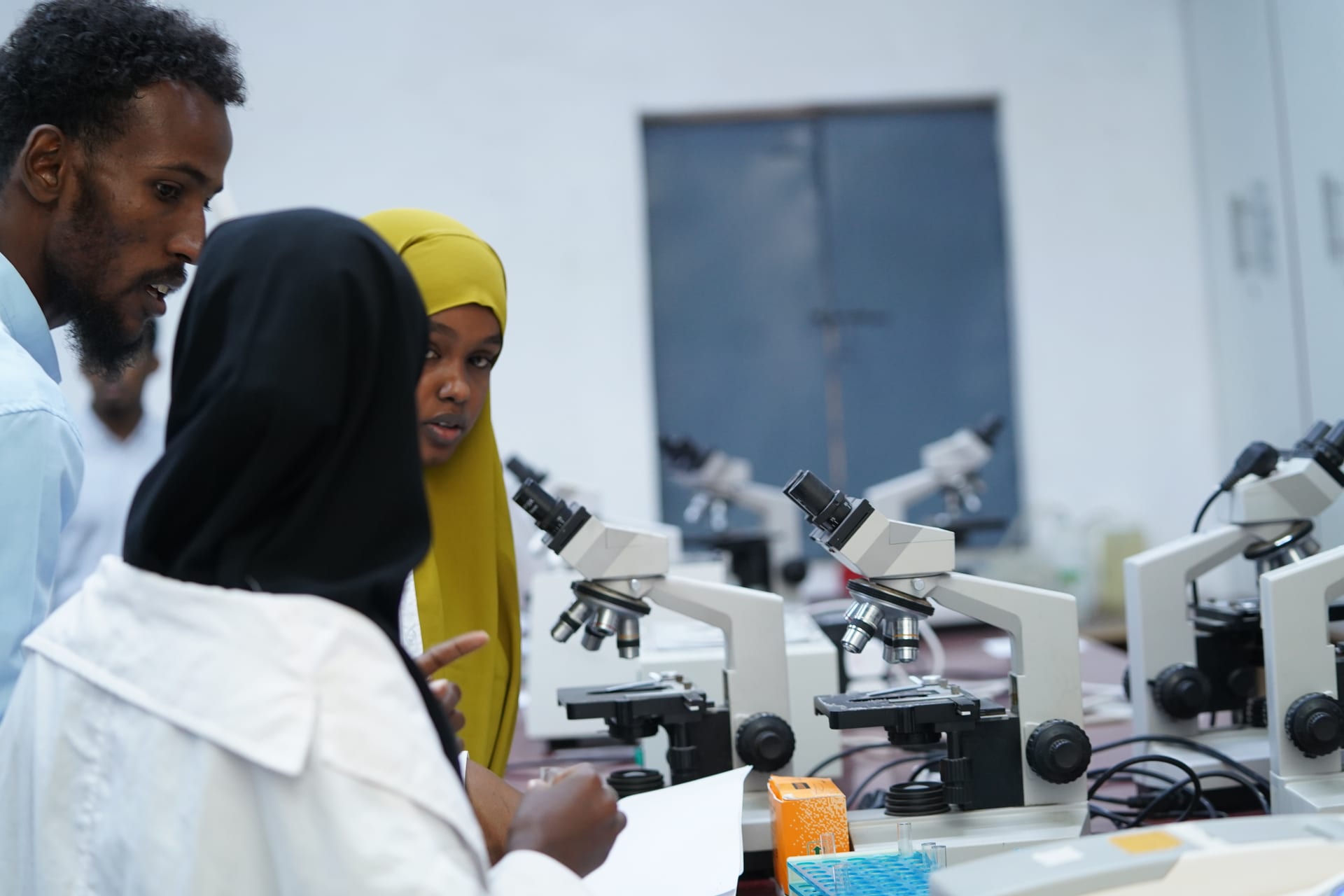
- Well-equipped simulation laboratories, computer laboratories, and a laboratory skills centre.
- University Library: access to laboratory science textbooks, journals, and online databases.
- Clinical training conducted in collaboration with partner hospitals, diagnostic laboratories, and healthcare centres.
Contact Information
Faculty of Health Sciences, Somali International University (SIU)